

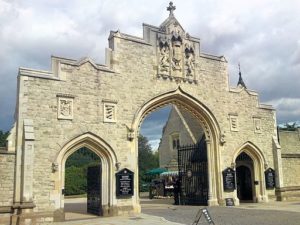
Cemetery policy doesn’t make the news very often, so when it does I tend to sit up and take notice. A report in the Guardian on 7 May therefore did catch my eye: “Cemetery finds sensitive solution to shortage of space”, read the headline.[1] The article was about the problem of cemeteries running out of space for burial and the “sensitive solution” pioneered by one particular cemetery, the City of London cemetery in Newham, namely to reuse existing graves at the site.
Beyond London pressure on burial space is an issue in other parts of the UK, including Scotland, and the recently passed Burial and Cremation (Scotland) Act[2] makes reuse possible in Scotland for the first time. The Scottish Government’s consultation paper issued last year in advance of the Bill indicated that the concerns of Scotland’s diverse faith communities would be paramount in the drafting of any legislation on reuse. Indeed, the consultation analysis report was prefaced with the aspiration to provide “a comprehensive overhaul and modernisation of the legislation relating to burial and cremation in Scotland to ensure it is fit for a multicultural 21st Century Scotland” (emphasis added).[3]
Furthermore, as regards the specific proposals for reuse, the consultation document stated:
“Where it is proposed to reuse lairs in cemeteries which are used for particular religious and faith groups or where a given lair is in a section of a cemetery used by a particular religious or faith group, the Burial Authority must specifically consult with that community. If the community objected to the proposal, reuse could not take place.”[4]
Such community consultation is particularly important for Muslim and Jewish communities, whose doctrines prohibit the disturbance of in situ human remains. Disturbance would inevitably occur in the case of the ‘lift and deepen’ reuse technique specified in the legislation. In Judaism it is forbidden to disturb the dead and the response of the Scottish Council of Jewish Communities (SCoJeC) to the Scottish Government’s consultation states very clearly: “Judaism regards the human body as sacrosanct, and requires that it should always be treated with dignity. This requirement applies not only before, but also after burial without any time limit.”[5] Similarly the Muslim Council of Scotland (MCS) stated in its response: “exhumation or any disturbance to the buried body are not allowed except in extreme circumstances.”[6]
Unfortunately these concerns of faith communities seem to have been ignored by Scottish Ministers. In the final text of the Act, the proposal to consult with faith groups has been removed. Instead, the only bodies which Burial Authorities must now consult with, according to the Act, are archaeologists, the Commonwealth War Graves Commission, and “any other person the burial authority thinks appropriate”[7] – about as vague a formulation as one could imagine.
It can only be hoped that in the forthcoming guidance and regulations to be prepared by Scottish Ministers on the subject of grave reuse, explicit instructions are given to Burial Authorities to consult with faith communities where the case demands it. Otherwise we may encounter situations in which the communities for whom eternal rest is in fact most sacrosanct are forced to transfer their loved ones out of Scotland for burial.
Rather than making burial a more available option for the Scottish public, as the legislation aims to do,[8] for some communities the outcome may in fact be the opposite.
References
[1] A longer online version of the print article is available: https://www.theguardian.com/environment/2016/may/06/re-using-graves-means-uk-cemetery-will-never-run-out-of-space
[2] Burial and Cremation (Scotland) Act, 2016
[3] http://www.gov.scot/Publications/2015/07/9665
[4] Scottish Government consultation paper
[5] SCoJeC response to consultation
[6] MCS response to consultation. Some Islamic theologians have argued that reuse of graves in Islam is permissible after a certain time period has elapsed: http://en.islamtoday.net/node/1160
[7] Burial and Cremation (Scotland) Act, 2016
[8] Scottish Government consultation paper, para. 59: http://www.gov.scot/Publications/2015/01/2869